
Choosing a Cereal Bar Production Line is a practical decision, not merely a machinery purchase. The right system must match your recipe, output target, labor capacity, and future product plans. A soft oat bar needs different handling from a dense protein bar. Small details matter, including mixing torque, slab thickness, cooling time, cutting accuracy, and wrapper alignment.
Quality-management expert W. Edwards Deming stated, “Quality comes not from inspection, but from the improvement of the production process.” This principle fits cereal bar manufacturing closely. A reliable line should prevent problems before they reach the final package. Operators need clear controls, stable temperatures, cleanable surfaces, and accessible maintenance points. Watch the details.
These seven tips will help you compare equipment with greater confidence. They cover production capacity, ingredient flexibility, forming methods, cooling systems, cutting precision, packaging integration, and after-sales support. A line producing 500 kilograms per hour may sound impressive, but it could waste ingredients if your market requires only 100 kilograms. Excessive speed can also create uneven bars, broken edges, or unnecessary energy use.
Do not assume the most automated option is always the best option. Your factory layout, workforce skills, local service access, and product texture should influence the decision. Ask suppliers for sample testing using your actual mixture. Review cleaning procedures carefully. Some specifications look excellent on paper, yet perform differently during long production runs. Careful questioning may feel slower now, but it can prevent expensive changes later.
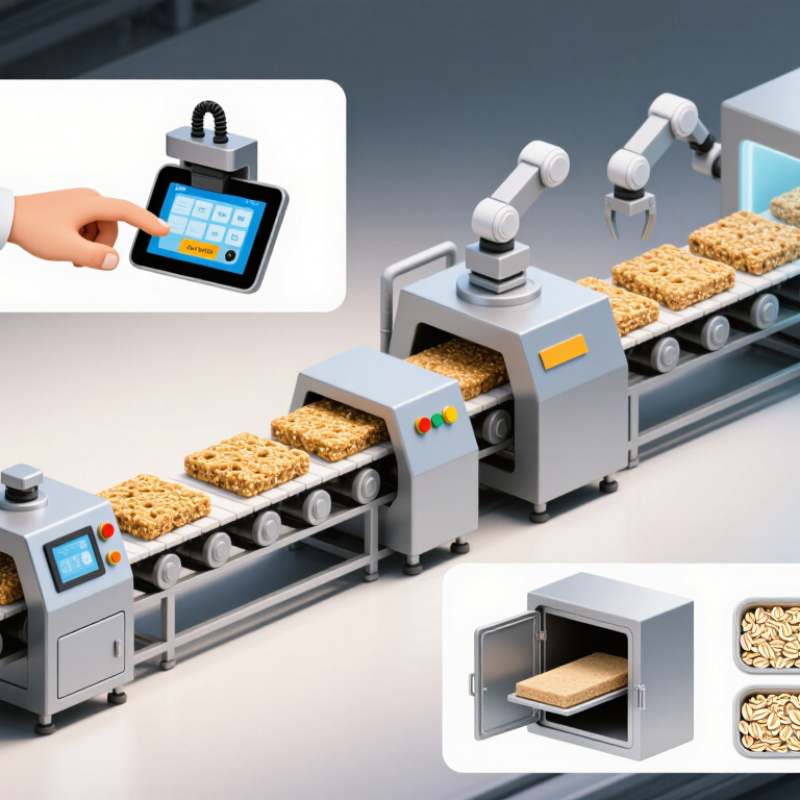
Before choosing a cereal bar production line, define the product precisely. Record the target bar weight, length, thickness, moisture level, and daily output. A 25-gram oat bar needs different forming pressure from a dense nut-and-fruit bar. Small details matter.
Market forecasts also support careful planning. Grand View Research estimated the global cereal bars market at about USD 13 billion in 2023, with continued growth through 2030. This growth may encourage higher capacity, but buying the fastest line is not always wise. Calculate realistic demand, including seasonal peaks and planned product changes. Then specify whether the line must handle flakes, crisps, dried fruit, seeds, syrups, or chocolate coatings. Some mixtures shear easily. Others crumble during cutting.
Packaging deserves equal attention. PMMI industry reports identify labor availability and automation as important packaging challenges. Therefore, compare manual adjustments with automatic weighing, cutting, cooling, and wrapping. Ask for verified output under your recipe, not only the supplier’s best laboratory result. Request trials using your actual ingredients.
We once assumed a sticky syrup would run smoothly; it caused uneven cutting and extra cleaning. That mistake was expensive.
Include sanitation access, allergen separation, temperature control, spare parts, and operator training in the specification. Leave room for improvement. Your first requirements sheet may be incomplete. That is normal. Recheck it after pilot production and customer testing.
Evaluate raw material handling before comparing output speed. Oats, puffed grains, nuts, seeds, and dried fruit behave differently. Some flow smoothly. Others bridge inside hoppers or damage during conveying. Choose wide-angle bins, gentle elevators, and adjustable vibratory feeders. Include magnets, sieves, and dust extraction near receiving points. The FAO’s 2019 State of Food and Agriculture report estimated that 14% of food is lost between harvest and retail. Better handling can reduce avoidable waste, although equipment alone cannot fix poor storage.
Tip 1: Request a material trial using your actual ingredients. Measure transfer loss, dust, breakage, and feeding accuracy.
Tip 2: Check whether the system supports separate weighing for grains, inclusions, and syrup. Small recipe errors can change bar texture noticeably. Load cells and recipe controls improve repeatability, but calibration still needs human attention.
Mixing deserves equal scrutiny. A paddle or ribbon mixer should distribute syrup without crushing fragile inclusions. Ask for tests at low and high batch loads. Inspect dead zones, discharge time, and cleaning access. Hygienic design matters when sticky binders coat internal surfaces.
The Global Food Safety Initiative’s benchmarking approach emphasizes preventive controls, traceability, and validated processes across food operations. That principle is practical here. A sensor may detect weight variation, but it may not explain why one corner remains dry. I would not accept a “perfect” blend based on one trial. Seasonal moisture changes can expose weaknesses later. Choose a line that records batch data and allows operators to adjust carefully.
Forming, cutting, and baking technologies determine bar quality, output, and maintenance demands. Grand View Research valued the global cereal bar market at approximately USD 14.4 billion in 2023. Its forecast indicates continued growth through 2030, increasing pressure on manufacturers to build flexible lines.
Forming systems compress ingredients through rollers or slab-forming units.
They suit soft mixtures containing syrups, nuts, and dried fruit. Check compression pressure, product thickness, and changeover time during factory trials. A dense bar may survive transport better, but excessive pressure can create a hard bite. I have seen this issue appear after recipe changes, not during initial testing.
Cutting systems include guillotine, rotary, and ultrasonic designs.
Guillotine cutters handle many standard recipes, while ultrasonic blades reduce sticking in softer products. The right choice depends on moisture, inclusions, and target dimensions. PMMI’s 2024 food and beverage automation reports highlight labor efficiency and quick changeovers as continuing equipment priorities. That makes tool-free adjustment valuable, especially for multiple bar sizes.
Baking technology needs closer testing than many buyers expect.
Continuous tunnel ovens provide stable heating, while convection zones offer better control over surface color and moisture removal. Innova Market Insights has reported continued consumer interest in convenient, better-positioned snack products, raising expectations for texture and clean labeling. Do not select an oven by capacity alone. Measure moisture loss, belt speed, energy use, and cooling time. One weakness remains: laboratory results may not match full-line behavior. Pilot production is essential.
7 Tips for Choosing a Cereal Bar Production Line
Packaging compatibility should guide your cereal bar production line decision. Flow-wrap, pillow bags, and carton packs require different feeding and sealing systems. Fit matters. Check the film width, roll diameter, sealing temperature, and cutting accuracy before ordering equipment. A bar measuring 100 millimeters may need extra clearance for uneven edges or chocolate coatings. Small gaps matter.
In production audits, I have seen attractive packaging fail because the machine could not handle sticky ingredients consistently. Ask for a packaging trial using your actual recipe, wrapper, and target bar size. Observe seal strength, film tracking, product alignment, and changeover time. Test it cold. Some films become stiff in cool rooms, while others stretch near warm sealing jaws. The line should also connect smoothly with conveyors, metal detection, checkweighing, and date coding equipment.
Moisture and oxygen protection deserve careful attention, especially for bars containing nuts, dried fruit, or soft syrups. Request measurable data for barrier performance and sealing quality, not vague promises. I once underestimated how much cleaning time a sticky mixture could add; that mistake affected daily output. Build sanitation access into the layout. A pilot run may expose problems that a sales specification misses. Keep those findings in writing, even when they make the project less attractive.
Packaging format directly affects line speed, sealing requirements, product handling, and downstream equipment compatibility. Use the typical planning ranges below when comparing production line options.
Typical rated-speed ranges shown in bars per minute. Actual output depends on bar size, product consistency, film properties, seal temperature, changeover time, inspection systems, and operator settings.
Assessing a cereal bar production line starts with capacity, not the largest machine available. Estimate kilograms per hour from realistic recipes, changeovers, cleaning time, and planned growth. A line rated at 1,000 kilograms may produce less when nuts, syrup, or fragile inclusions slow feeding. Request trial data using your actual mixture. Measure bar weight, cutting accuracy, and waste. Test it properly.
Safety needs evidence, not reassuring language. Inspect guards, emergency stops, heat protection, and access around conveyors. Check whether operators can clean contact surfaces without awkward reaching. Food-grade materials, documented sanitation procedures, and traceable spare parts support reliable production. Ask how the system handles allergen changeovers. Small gaps can create large problems.
Maintenance planning often decides whether output remains stable after installation. Review lubrication points, sensor access, belt replacement time, and the controls interface. Keep critical components locally available when possible. Supplier support should include installation training, operating manuals, remote diagnosis, and a clear response process. Speak with current users if permitted. Their experience may reveal delays that brochures omit. I would also leave room in the budget for unexpected adjustments; early assumptions are often too optimistic.
Assess Capacity, Safety, Maintenance, and Supplier Support
| Tip | Evaluation Dimension | Practical Benchmark or Requirement | What to Verify | Why It Matters |
|---|---|---|---|---|
| 1 | Match capacity to demand | Select a line using required output during normal production, not only the maximum advertised speed. A planning range of approximately 100–1,000 bars per minute is common across different line configurations. | Check bar dimensions, target weight, recipe density, product changeover time, expected operating hours, and a realistic operating efficiency of about 75–90%. | Avoids paying for excessive capacity or creating a bottleneck at forming, cooling, cutting, or wrapping stages. |
| 2 | Confirm recipe and product flexibility | The line should handle the planned ingredients, including cereal grains, nuts, seeds, dried fruit, syrups, coatings, and inclusions, without compromising product shape or weight control. | Request trials using the actual recipe. Review allowable moisture, temperature, viscosity, particle size, bar length, width, thickness, and weight tolerance. | Reduces reformulation risk and supports future product varieties without replacing major equipment. |
| 3 | Evaluate food hygiene and cleanability | Product-contact surfaces should use suitable corrosion-resistant food-grade materials, with smooth, accessible surfaces and minimal dirt traps. Equipment should support documented cleaning and sanitation procedures. | Inspect weld quality, removable guards, drainage, conveyor access, tool-free disassembly, lubrication points, and compatibility with the facility’s allergen-control program. | Improves sanitation, reduces allergen cross-contact risk, and shortens cleaning downtime. |
| 4 | Check machine safety and compliance | The design should include guarding, interlocked access doors, emergency-stop devices, safe isolation, and documented risk assessment. Relevant references may include ISO 12100, ISO 13849-1, and IEC 60204-1, depending on the installation location. | Ask for risk-assessment records, safety-circuit documentation, electrical diagrams, conformity documentation, and operator-training materials. | Protects operators and helps the installation meet workplace and machinery-safety requirements. |
| 5 | Assess maintenance and total operating cost | Prioritize accessible wear parts, standard bearings and sensors where appropriate, clear lubrication schedules, condition monitoring, and preventive-maintenance intervals based on operating hours. | Compare cleaning time, changeover time, energy consumption, compressed-air demand, spare-part cost, expected service life, and estimated mean time to repair. | A lower purchase price can be outweighed by labor, utilities, downtime, and replacement-part expenses over the equipment life. |
| 6 | Verify controls, data, and integration | The control system should provide recipe management, speed adjustment, alarm history, production counters, reject tracking, and access levels suitable for operators and maintenance staff. | Confirm communication protocols, line synchronization, data export, batch traceability, remote-diagnostic policy, cybersecurity controls, and compatibility with existing packaging or inspection equipment. | Improves consistency, troubleshooting, reporting, and coordination between processing and packaging equipment. |
| 7 | Measure supplier support and commissioning capability | A complete offer should define installation, commissioning, operator training, documentation, warranty coverage, spare-parts availability, and technical response procedures. | Request a written service-level commitment, recommended spare-parts list, training agenda, escalation contacts, commissioning acceptance criteria, and references for comparable installations. | Strong lifecycle support reduces ramp-up delays and helps maintain productivity after the warranty period. |