
A Baby food pouch can simplify global sourcing when convenience, safety, and consistent quality matter. Parents value lightweight packs, clean dispensing, and easy storage in a handbag or kitchen drawer. Manufacturers also gain efficient filling, controlled portions, and lower transport weight than many rigid containers. These benefits explain the format’s growing international appeal.
Dr. Alan Greene, a pediatrician and infant-feeding authority, has said, “The best food for your baby is the food you make yourself.” His reminder adds necessary balance. A pouch should support responsible feeding, not replace thoughtful nutrition or shared mealtimes. Buyers must examine ingredient quality, age suitability, oxygen barriers, seal strength, and batch traceability. Small details matter. A weak spout seal can ruin an entire shipment.
For international purchasing teams, supplier evaluation should include factory audits, food-contact documentation, migration testing, and reliable quality-control records. Packaging structures also deserve close attention. Recyclability claims can sound attractive, yet multilayer films may remain difficult to recover in local systems. This is where sourcing decisions become less comfortable. A cheaper package may create higher environmental costs later.
My view may be too optimistic. Convenience often receives more attention than lifecycle performance. Still, careful buyers can improve outcomes by requesting transparent material specifications, realistic minimum order quantities, and samples tested under heat, pressure, and long-distance transport. The strongest supplier is not simply the lowest-priced one. It is the partner that communicates problems early, documents every batch, and keeps improving the Baby food pouch without compromising infant safety.
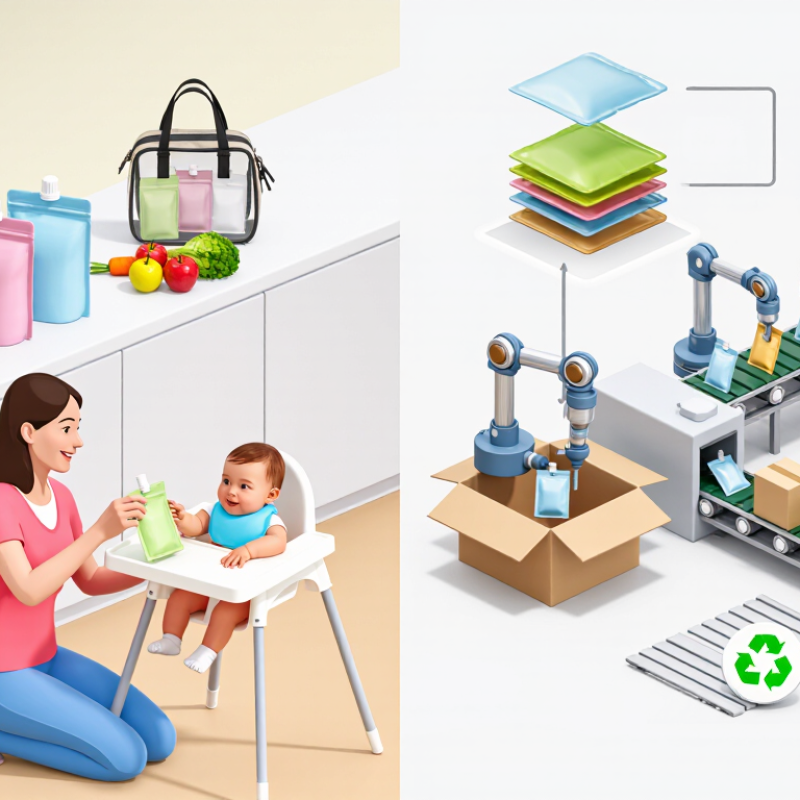
Baby food pouches are flexible containers, usually made from layered plastic films, with a sealed body and a small spout. The layers can help protect food from moisture, oxygen, and light, depending on their materials and construction. A caregiver opens the cap, then squeezes the puree through the spout onto a spoon or into a bowl. Some children also suck directly from the pouch, though this can make portion awareness harder. Small detail, but it matters.
The format reflects a broader packaging industry. The Flexible Packaging Association’s 2023 State of the U.S. Flexible Packaging Industry report estimated U.S. flexible packaging sales at $42.5 billion in 2022. That figure covers many product categories, not baby food alone, but it shows the scale of the format’s supply chain. For global sourcing, buyers should check pouch dimensions, seal strength, material structure, and compatibility with the filling and processing method. A pouch that looks sturdy on a sample may behave differently after transport or heat treatment. This is easy to overlook. Caps and seals also need practical testing, since a small leak can spoil an otherwise well-made pack.
Baby food pouches suit global sourcing because they are light, compact, and efficient to ship. Compared with rigid jars, flexible formats can reduce packaging weight and transport volume. The Flexible Packaging Association reports that flexible packaging uses less material than many alternative formats. This can support lower freight costs and simpler warehouse handling. Pouches also offer convenient portion control for parents and caregivers.
Global sourcing requires more than low unit prices. Pouches can be produced through different certified facilities, supporting regional supply continuity. Their flat shape improves pallet use before filling. After filling, many formats provide strong oxygen and moisture barriers. This helps protect texture and nutrients during long distribution routes. However, I would not call pouches perfect. Recycling systems remain inconsistent across countries. That assumption needs testing.
Tips: Request migration testing, seal-strength results, and shelf-life evidence from suppliers. Confirm compliance with the destination market’s food-contact rules. Review filling temperatures, spout designs, and batch traceability. The World Health Organization recommends complementary foods from around six months, while safety and nutritional suitability remain essential. Grand View Research’s recent packaging analyses also identify convenience and lightweight design as important market drivers. Buyers should compare total landed cost, not only factory pricing. A cheaper pouch may create higher inspection, waste, or return costs.
Baby food pouches usually combine lightweight structure with controlled dispensing. Their materials shape shelf life, safety, and recycling options. A typical multilayer pouch may use polyethylene or polypropylene for food contact and heat sealing. Some formats add PET for stiffness or EVOH for oxygen protection. Aluminum foil can improve barriers, but it may complicate recycling. Material selection should follow the recipe, filling process, and target market.
Design details matter during real handling. A wide opening can simplify filling and cleaning checks. A narrow spout helps reduce spills around a child’s mouth. Secure caps, tamper evidence, rounded corners, and strong seals support safer use. Stand-up gussets improve shelf stability and storage efficiency. Clear windows may help caregivers inspect texture, although they can reduce barrier performance. Small choices create large differences.
Testing should cover seal strength, drop resistance, leakage, migration, and storage conditions. Suppliers should provide traceable material declarations and food-contact documentation for each market. I would not assume one pouch design fits every country or recipe. High-acid purées, oily foods, and heat-treated products behave differently. A pouch can look excellent yet fail after transport. That uncomfortable possibility deserves attention. Practical sampling, aging tests, and production audits often reveal weaknesses that drawings cannot show.
Baby food pouches can simplify global sourcing, but supplier evaluation demands more than attractive packaging. Buyers should verify ingredient origins, processing controls, and pouch performance before placing large orders.
The WHO estimates that 600 million people become ill from contaminated food each year. That figure makes preventive controls essential, even for shelf-stable products.
Request recent certificates, batch records, allergen controls, and certificates of analysis for every production lot. Check whether the supplier follows HACCP and Codex food hygiene principles. ISO 22000 certification can support confidence, but it should not replace an independent factory audit.
Test pouch seals, oxygen transmission, filling accuracy, and retort stability. A pouch may look perfect while its seal weakens after heat treatment. Nutritional results also need laboratory verification, especially for iron, sugar, and vitamin claims.
The UNICEF and WHO 2023 Global Breastfeeding Scorecard reported a 48% global exclusive breastfeeding rate for infants under six months.
Complementary foods therefore need age-appropriate nutrition and clear preparation guidance.
Tips:
Ask for three retained samples from different batches. Open one after simulated transport. Inspect odor, texture, leakage, and print quality. Compare laboratory results with the product specification, not only the supplier’s brochure.
Review recall procedures and traceability exercises. A supplier may pass an audit once, yet perform unevenly later.
I would keep a second approved source where practical. Cost savings can disappear quickly after a delayed shipment or failed inspection.
Why Choose Baby Food Pouches for Global Sourcing?
International baby food pouch sourcing requires more than comparing prices and materials. Regulations affect every stage, from resin selection to warehouse release. Packaging must meet food-contact safety rules in the destination market. These rules may limit substances that can migrate into food. They can also require testing for inks, adhesives, plastic layers, and closures.
In practical sourcing work, suppliers should provide current declarations of compliance and migration test reports. Auditors often review hygiene controls, production records, and traceability systems. HACCP-based procedures and good manufacturing practices are widely expected. They help identify risks near filling, sealing, and transport. A certificate alone is not enough. Documents must match the actual pouch structure and production site.
Labeling creates another challenge. Baby food packaging may need local language, allergen statements, age guidance, nutrition information, lot codes, and expiry dates. Importers may remain responsible for accuracy, even when suppliers prepare the artwork. Recycling rules also differ between markets. A multilayer pouch may protect food well but create disposal concerns. This conflict deserves early review. Requirements can change, and online summaries may be outdated. Buyers should confirm rules with competent local authorities before placing large orders. Small details matter, such as seal strength after heat treatment and whether printed surfaces contact food. Mistakes are possible, especially when one pouch design serves several countries.
| Regulatory area | Market or reference | What it covers | Global sourcing checks |
|---|---|---|---|
| Food-contact packaging | United States: FDA food-contact regulations, including 21 CFR Parts 174–178 | Materials and substances used in food-contact components must be suitable for their intended use and comply with applicable authorizations and conditions. | Obtain documentation for each pouch layer, closure, ink, coating, and adhesive. Confirm the intended food type, contact conditions, and applicable FDA regulatory basis. |
| Food-contact packaging | European Union: Regulations (EC) No 1935/2004 and (EU) No 10/2011; Regulation (EC) No 2023/2006 | The framework covers food-contact materials, good manufacturing practice, and specific requirements for plastic materials, including applicable migration limits and documentation. | Request material specifications and applicable declarations of compliance. Check migration testing against the actual pouch structure, food, shelf life, and filling or retort conditions. |
| Food safety and preventive controls | United States: FDA 21 CFR Part 117; importer requirements under the Foreign Supplier Verification Program (21 CFR Part 1, Subpart L) | Applicable facilities must meet relevant current good manufacturing practice and preventive-control requirements. Covered importers have risk-based foreign-supplier verification duties. | Assess facility registration and compliance where applicable, hazard analysis, process controls, sanitation, supplier approval, records, and the importer’s documented verification plan. |
| Food hygiene and traceability | European Union: Regulations (EC) No 178/2002 and No 852/2004 | These rules establish general food-safety responsibilities, traceability obligations, and food-hygiene requirements for relevant food businesses. | Verify lot coding and records link ingredients, processing, packaging, and shipments. Confirm hygiene controls and that a practical product-withdrawal or recall process is in place. |
| Labeling and allergens | United States: FDA food-labeling rules, including 21 CFR Part 101; European Union: Regulation (EU) No 1169/2011 | Requirements can cover ingredient lists, allergen declarations, nutrition information, net quantity, language, and other mandatory label particulars. Details vary by market and product classification. | Review the final label for each destination market. Reconcile ingredient and allergen statements with recipes and production controls, and verify required language and nutrition formats. |
| Foods for infants and young children | European Union: Regulation (EU) No 609/2013 and relevant delegated rules; Codex standards CXS 73-1981 and CXS 74-1981 | Special rules may apply depending on whether a product is classified as processed cereal-based food, baby food, or another category. Codex standards provide international reference points but are not automatically national law. | Determine the product’s legal category, intended age group, composition, and permitted claims in each market. Do not assume rules for infant formula also apply to complementary foods in pouches. |
| Contaminants and chemical hazards | Destination-market rules; for the EU, Regulation (EU) 2023/915 sets maximum levels for specified contaminants in certain foods | Limits and controls depend on the contaminant, ingredient, food category, and jurisdiction. There is no single universal contaminant limit covering every baby food pouch worldwide. | Use risk-based testing for relevant ingredients and finished products. Compare results with the current legal limits for each destination and retain laboratory reports and lot-level records. |
| Cross-border compliance planning | All importing markets | Requirements differ by destination, product category, manufacturing process, packaging construction, and intended use. A pouch that complies in one market is not automatically compliant in another. | Before placing an order, map the destination-country rules, confirm importer responsibilities, approve the product and packaging specifications, and have qualified regulatory specialists review market-specific requirements. |