
Choosing a Filter Basket supplier in China takes more than comparing prices and polished product photos. The right partner must understand the application, document materials, and produce repeatable dimensions. A basket can look flawless on a sample table. Under pressure, it may tell a different story.
For this introduction, filtration sourcing specialist Lin Wei is presented as a fictional expert voice, not a verifiable industry authority. The practical reminder is: “A basket that matches the drawing but fails in service is not a successful purchase.” Buyers should check mesh size, wire grade, weld quality, tolerances, and finish against clear specifications. Ask how the supplier controls production between sample approval and repeat orders. Request material records and inspection results where relevant. Then compare lead times, packaging, and communication—not price alone.
Details matter. A small weld bead can snag debris; an uneven rim can prevent a secure fit. Request close-up photographs, dimensional reports, and a pre-production sample. If possible, arrange an independent inspection. Still, no checklist removes every risk. I would not treat a confident sales reply as proof of factory capability; that assumption is easy to make and hard to defend. This guide will help buyers assess supplier experience, production controls, quality evidence, and practical responsiveness before committing. The goal is not to find the cheapest basket. It is to find a supplier whose process can be checked, discussed, and improved when something falls short. A little caution helps.
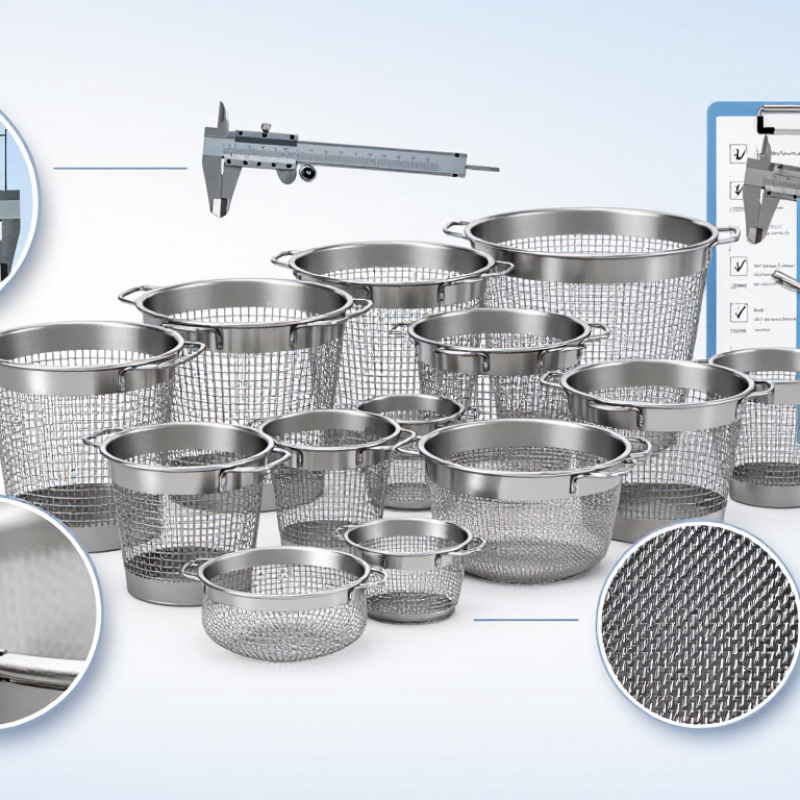
When comparing filter basket suppliers in China, begin with the dimensions of your actual housing, not a catalog image. Specify the basket’s outer diameter, height, rim shape, handle clearance, and connection points. Small errors matter. A basket that is only a few millimeters too wide may jam when hot or loaded with debris. Ask the supplier to confirm tolerances on a dimensioned drawing before production.
Micron rating should match the particles you need to capture and the flow your process can tolerate. A finer mesh may reduce flow or clog sooner, especially with viscous liquids. Define whether the rating is nominal or absolute, and request mesh data or a sample for inspection. I used to focus too much on the stated micron number; the open area and wire thickness matter too. Test it wet.
Provide the target flow rate and the fluid’s operating conditions, including temperature and viscosity. Then state the design pressure and any pressure spikes the basket may encounter. Ask how the supplier verifies deformation resistance and weld quality, and request test records tied to the proposed material and construction. A pressure value without test conditions tells you little. If the first specification feels incomplete, revise it with your process engineer before requesting a final quotation.
When evaluating a filter basket supplier in China, compare the quoted opening with a recognized measurement standard—not just a “mesh count.” ASTM E11’s standard sieve series lists nominal openings from 20 μm to 125 mm, with specified tolerances for test sieves. Ask for the exact aperture, wire diameter, material, and inspection method. A 200 μm opening made with thicker wire can behave differently from one made with finer wire, even when both are described as the same mesh size.
Check the supplier’s inspection records against the relevant ASTM E11 opening and tolerance tables. Request a sample report showing measured openings, not only a general certificate. For example, ask how the supplier checks several points across the basket, including near seams where openings may distort. Note that ASTM E11 is a test-sieve specification; it is a useful reference, but it does not automatically certify every filter basket. A small mismatch can matter.
Tips: Send a drawing with the target opening and tolerance, then confirm whether the basket uses woven mesh or perforated sheet. Ask for photographs under magnification and a measurement report tied to the sample lot. If the supplier cannot explain the measuring method, pause. It may be worth checking the details again.
Selected nominal openings shown on a logarithmic scale.
These are selected nominal opening sizes from the ASTM E11 sieve series, converted to micrometers for comparison. When evaluating a filter basket supplier, confirm the requested opening size, applicable tolerances, and inspection documentation against the current standard.
When comparing filter basket suppliers in China, start with the steel grade, not the quoted price. Type 304 stainless steel suits many general-purpose applications, including clean water and indoor filtration. Type 316L contains about 2–3% molybdenum, which improves resistance to chloride-related pitting. That difference matters near saltwater, coastal air, or chloride-bearing process fluids. It is not a guarantee against corrosion.
Ask suppliers to identify the grade on material certificates and explain how they verify it. A handheld alloy analyzer can help check incoming material, while certificates support traceability. For welded baskets, 316L’s low carbon content can reduce the risk of weld-related corrosion. Still, poor welds, rough edges, or trapped residue can undermine either grade. Details matter.
Request a sample with the proposed mesh, wire diameter, seam, and finish. Inspect the openings under steady light; uneven spacing can affect filtration. Ask how the basket is cleaned after fabrication, especially if the process leaves heat tint or polishing residue. Small checks. Also consider fluid temperature, cleaning chemicals, and exposure time before choosing a grade. I would not assume 316L is always the better purchase: for mild conditions, 304 may be adequate, while harsh service needs a more specific corrosion review.
When evaluating a filter basket supplier in China, treat ISO 9001:2015 as a starting point, not proof of product quality. Ask to see the current certificate, its scope, issuing body, and latest surveillance record. Check that the listed site actually makes or inspects the baskets. A certificate can be valid while a process remains inconsistent. That matters.
Walk the production records from incoming wire or sheet to packed basket. Material certificates should identify the grade, heat or lot number, and material source. Operators should link those details to job cards and finished batches. Try a sample trace exercise: select a basket and ask staff to retrieve its material record, drawing revision, inspection results, and shipment date. Notice how long it takes. If records depend on one person’s memory, traceability is fragile.
Review inspection methods, not just a polished quality manual. Ask how aperture size, weld strength, dimensions, burrs, and corrosion resistance are checked. Confirm that measuring instruments are calibrated. Request recent test reports for comparable production, with acceptance limits and records of corrective actions. A video call can show gauges and inspection stations, but it cannot replace an on-site audit when volumes or risks are high. Compare several production samples, too; one perfect sample proves little. No audit catches everything. Leave room for follow-up.
Supplier audit checklist for filter baskets. Review objective evidence against the product specification, drawing, and agreed purchase requirements.
| Audit Dimension | What to Verify | Objective Evidence to Request | Evaluation Record |
|---|---|---|---|
| ISO 9001:2015 certification | Confirm the certificate is current and its stated scope covers relevant manufacturing or processing activities. | Certificate, issuing certification body, validity dates, stated sites and scope. Verify certificate details with the issuer or an appropriate accreditation directory where available. | Certificate valid: ☐ Yes ☐ No Scope relevant: ☐ Yes ☐ No Notes: __________ |
| Quality management processes | Check that documented processes control orders, drawings, production changes, inspection, and product release. | Process map or procedures; a sample order-to-inspection record; revision-controlled drawing and specification; evidence that changes are reviewed and communicated. | Records reviewed: __________ Gaps: __________ |
| Control of external providers | Review how the supplier selects and monitors outside providers for wire mesh, sheet, welding, surface treatment, or other outsourced work. | Approved-provider criteria, purchase requirements, incoming inspection records, and examples of actions taken when supplied material or services failed requirements. | Controls adequate: ☐ Yes ☐ No Notes: __________ |
| Material identification and traceability | Confirm that material identity can be linked from receipt through production to the finished basket, at the level agreed for the order. | Receiving records and lot or heat identification; traceability example linking a finished item or batch to its material records; documented handling of mixed or unidentified material. | Traceability demonstrated: ☐ Yes ☐ No Sample reference: __________ |
| Material certificates | Check that the supplied grade and product form match the purchase specification and that certificates relate to the delivered material. | Material test certificate or other agreed material documentation, such as an EN 10204 3.1 inspection certificate where specified; matching grade, heat or lot reference, and supplier records. | Grade matches specification: ☐ Yes ☐ No Documents complete: ☐ Yes ☐ No |
| Incoming and in-process inspection | Verify inspection points are defined for relevant characteristics, such as wire diameter, mesh opening, basket dimensions, welds, and finish. | Inspection plan, acceptance criteria tied to the approved drawing or specification, completed inspection records, and examples of measured results. | Inspection records reviewed: __________ Notes: __________ |
| Measuring equipment | Check that instruments used for acceptance decisions are suitable, identified, and maintained or calibrated as appropriate. | Equipment list; calibration or verification records; instrument identification on sample inspection records; actions taken for equipment found out of tolerance. | Equipment controls adequate: ☐ Yes ☐ No Notes: __________ |
| Product and performance testing | Agree tests and acceptance limits before production. For filtration performance, define the test method and conditions rather than relying on an unexplained micron-rating claim. | Test procedure and report identifying the sample, method, conditions, results, and acceptance criteria. Depending on the specification, tests may address dimensions, flow, retention, or other defined performance characteristics. | Method agreed: ☐ Yes ☐ No Report available: ☐ Yes ☐ No |
| Corrosion or surface testing | Where required by the application, verify that the test method, exposure conditions, and acceptance criteria are specified and relevant to the agreed material and finish. | Applicable test standard or agreed procedure, test conditions, sample identification, results, and disposition. Do not treat an unspecified corrosion test as proof of suitability for every service environment. | Required for this order: ☐ Yes ☐ No Evidence reviewed: __________ |
| Nonconforming product and corrective action | Check how defects are identified, segregated, reviewed, and corrected, and how recurring problems are investigated. | Nonconformance records, disposition and rework approvals where applicable, corrective-action examples, and verification that corrective actions were effective. | Process demonstrated: ☐ Yes ☐ No Notes: __________ |
| Final release and shipment records | Confirm finished goods are released against agreed requirements and can be matched to the order and shipment. | Final inspection or release record; product identification; packing list; batch or lot reference where required; and records of any approved deviation. | Release evidence complete: ☐ Yes ☐ No Notes: __________ |
| Audit conclusion | Summarize evidence, unresolved risks, and any corrective actions before approval or order placement. | Record the audit date, documents sampled, open findings, responsible person, and due date for each action. | Decision: ☐ Approve ☐ Conditional ☐ Hold Follow-up date: __________ |
Scoring option: If a numerical score is useful, apply the same documented scale to every audit item—for example, 0 = no adequate evidence, 1 = partial evidence or action required, and 2 = adequate evidence observed. Set approval thresholds internally; ISO 9001:2015 certification alone does not guarantee that a particular product meets its specification.
Compare Samples, MOQ, Lead Time, and Total Cost Before Supplier Selection
A useful comparison starts with one clear specification sheet. List basket diameter, height, mesh size, material, finish, and handle dimensions. Send the same requirements to each supplier. This makes quotations easier to compare. Ask for physical samples, not just photos. Check whether the rim sits flat, the mesh feels even, and the handle stays secure when the basket is full. Small details matter.
MOQ can change the real cost. A low unit price may require an order larger than your storage space or sales forecast supports. Ask whether the supplier can offer a trial quantity, and confirm if setup fees apply. Lead time needs similar care. Request separate estimates for sample preparation, production, inspection, and shipping. Build in extra time for revisions. Delays happen.
Compare the total landed cost, including packaging, tooling, freight, and any inspection charges. Ask for an itemized quotation and confirm the currency and quote validity period. One limitation is easy to miss: a sample may be hand-finished, while bulk units follow a faster process. Ask how production pieces will be checked and what happens if dimensions fall outside the agreed tolerance. Recheck the sample against your actual filter holder before approving the order.