
Copper stamping is gaining strategic importance as manufacturers pursue lighter, more conductive, and highly repeatable components. The Copper Stamping Machine supports terminals, busbars, connectors, heat sinks, and automotive Electrical Parts. Its performance depends on press force, die accuracy, feed control, copper alloy behavior, and production speed.
The Grand View Research report on metal stamping estimated the global market at approximately USD 257 billion in 2022. Its analysis also identifies automotive, electronics, and industrial equipment as major demand sectors. Meanwhile, the International Copper Study Group continues to monitor strong copper consumption linked to electrification, renewable energy, and grid investment. These trends create opportunities for machine manufacturers, but they also increase pressure on energy efficiency and scrap reduction.
Professor Taylan Altan, a widely recognized authority in sheet-metal forming, has stated, “The stamping process is a complex operation involving many variables.” That observation remains highly relevant. A fast press is not automatically a good press. Poor lubrication, unstable strip feeding, or excessive tool wear can quickly damage expensive copper stock.
This Top 10 Copper Stamping Machine Manufacturers Worldwide ranking examines engineering capability, automation, tooling support, after-sales service, and global customer experience. Public market reports provide useful direction, but they rarely separate copper-specific machines from broader metal-stamping equipment. That limitation matters. Therefore, the ranking combines available company data with practical manufacturing considerations, while acknowledging that regional pricing and performance claims require independent verification. No ranking is perfect. Real factory results can differ.
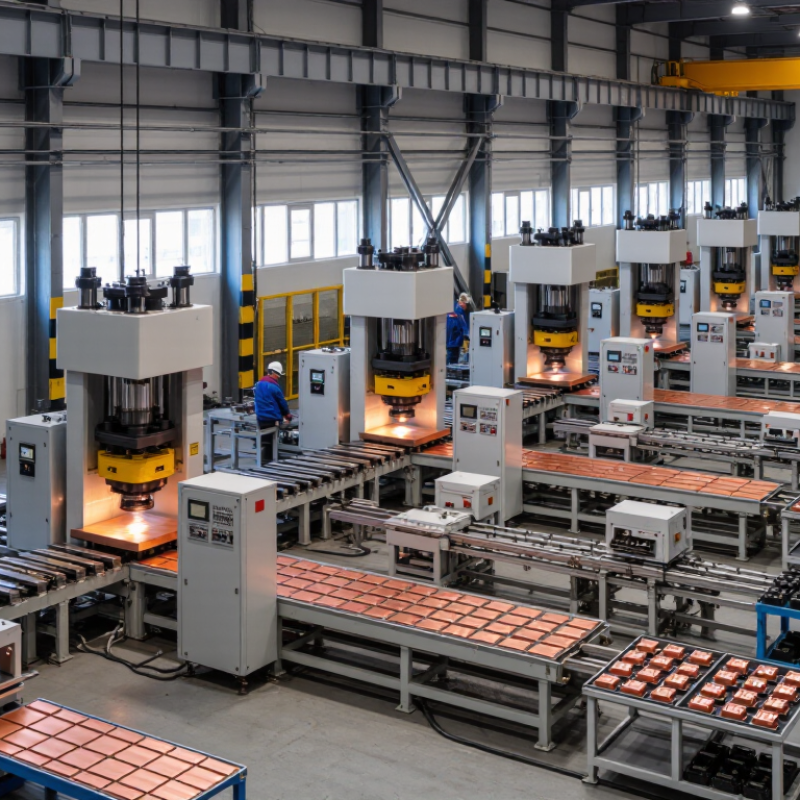
Top 10 Copper Stamping Machine Manufacturers Worldwide?
A copper stamping machine uses a press, die, feeder, and controlled force to shape copper strip or sheet. The die cuts, bends, pierces, or forms parts at repeatable speed. These machines produce terminals, electrical connectors, busbars, shielding components, and heat-transfer parts. The copper usually arrives as a coil, then moves through the tooling station by station. The die decides.
Industrial value comes from conductivity and consistency. The International Energy Agency’s Global Critical Minerals Outlook 2024 projects copper demand could rise from about 26 million tonnes in 2023 to 36 million tonnes by 2040. Electrification increases pressure on component makers. Stamping reduces material waste compared with many machining processes, but scrap still depends heavily on nesting, clearance, and strip thickness. Small errors matter.
In production audits, engineers should examine press force, stroke rate, feed accuracy, die life, and burr control. High-speed lines may exceed hundreds of strokes per minute, yet speed alone proves little. The U.S. Department of Energy identifies copper as essential for motors, power systems, and electrification equipment. That evidence supports stronger demand for reliable forming capacity. Still, a tidy specification can fail beside an unstable coil or poorly maintained die. My own assumption needs correction: automation improves repeatability, but it cannot repair weak tooling design. Temperature, lubrication, and operator inspection remain practical variables.
Evaluating global copper stamping machine manufacturers requires more than comparing catalog prices. A reliable assessment begins with machine performance on real copper grades, including strips used for terminals, connectors, and electrical components. Inspectors should review stamping force, stroke speed, feeder accuracy, and die alignment. Tiny alignment errors can create burrs or uneven edges.
Factory experience matters. Request sample parts, production records, and maintenance histories. A serious manufacturer can explain how its machines handle copper’s conductivity, softness, and springback. Look for measurable results, such as burr height, dimensional tolerance, cycle stability, and output during an eight-hour trial. Ask whether operators received practical training. Good documentation is useful, but direct evidence is stronger.
Safety and service deserve equal attention. Check emergency controls, guarding, electrical protection, spare-part availability, and response times across regions. Certifications should be current and traceable, not merely displayed in brochures. Review customer references from similar industries, especially facilities producing high-volume electrical parts. A polished website proves little. A live factory test proves more. However, no evaluation is perfect. Test conditions may favor one machine, while long-term wear remains uncertain. I would record both verified strengths and unresolved questions before ranking any manufacturer.
The global copper stamping machine market reflects rising demand for precise electrical components. The International Copper Study Group reported refined copper usage above 26 million metric tons in 2023. This demand supports investment in stamping equipment for terminals, busbars, connectors, and heat-transfer parts.
A credible worldwide top-10 comparison should examine more than press tonnage. Experienced buyers inspect feed accuracy, die alignment, cycle stability, and burr control.
Machines handling 0.2 to 3 millimeter copper strip require carefully controlled clearance. Even a small edge burr can increase contact resistance or damage insulation. High-speed servo presses may exceed 500 strokes per minute, but speed alone does not prove quality. Production trials matter.
Reports from Grand View Research place the global metal stamping market above 200 billion US dollars in recent estimates. This scale encourages manufacturers to offer modular automation, in-line inspection, and energy monitoring.
Strong suppliers also provide die maintenance training and measurable service response times. Yet rankings remain imperfect. Public data often mixes copper stamping with broader metal-forming equipment.
Buyers should request sample parts, tooling-life records, noise measurements, and scrap-rate evidence before selecting a manufacturer. A polished brochure is not enough.
Comparing machine types, capabilities, and manufacturing regions helps buyers judge more than production speed. Mechanical presses suit high-volume copper terminals and simple profiles. Servo presses offer better control for delicate connectors, variable strokes, and reduced material distortion. Hydraulic machines provide steady force for deeper forming, although their cycle rates are usually lower. Progressive and transfer systems improve automation when parts require several forming stages.
Manufacturing regions often reflect different engineering strengths. East Asian suppliers commonly emphasize compact layouts, fast feeding systems, and competitive customization. European manufacturers often focus on energy efficiency, safety integration, and precise motion control. North American producers may provide robust service networks and heavy-duty configurations. Southeast Asian factories increasingly offer practical mid-range equipment for expanding production lines. In factory visits, I have seen impressive specifications fail when feeder alignment or die support was weak. A ranking can mislead.
Tips: Match press tonnage to the copper alloy, thickness, and forming depth. Check stroke consistency, feed accuracy, spare-parts access, and local technician support. Request sample trials using your actual strip material. Ask for measured noise, cycle-time, and rejection data. Small details matter. Also, leave capacity for future tooling changes; a machine optimized too narrowly may become expensive later. Even experienced teams sometimes overvalue speed and underestimate maintenance access.
Choosing from a top-ten manufacturer list is only a starting point. The right supplier must match your copper grade, strip thickness, production volume, and part geometry. Ask for tested samples using your actual material. A machine that performs well with thin copper may struggle with thicker busbar components.
Check press force, stroke speed, feeder accuracy, and die compatibility. Request clear data for hourly output, dimensional tolerance, noise, and energy use.
Reliable manufacturers explain these figures instead of making broad promises. Their engineers should review your drawings, suggest suitable tooling, and identify possible material deformation before purchase.
Tips: Compare at least three technical proposals. Visit a working installation when possible. Inspect the control cabinet, lubrication points, safety guards, and spare-parts storage. Ask how quickly service engineers respond. A low purchase price can become expensive when downtime lasts several days. Warranty terms also need careful reading, especially for dies and electronic components. Consider operator training and software support, not only machine speed. One imperfect detail deserves attention: advertised output often assumes ideal feeding and regular maintenance. Your factory may not have either. Run a realistic trial before signing the final agreement.