
Choosing among the Best Pneumatic Butterfly Valve Manufacturers in China takes more than comparing prices or polished catalogs. A Pneumatic Butterfly Valve may look simple on a drawing, yet its performance depends on the disc, seat, shaft, actuator, and operating conditions working together. Small details matter. A seat that suits clean water may not suit abrasive slurry, while an actuator sized only for normal pressure may struggle during a pressure spike.
Béla Lipták, a respected process-control authority, offers a useful principle in his published work: equipment choices should fit the process. Paraphrased for valve selection: “Choose for the operating conditions, not the catalog.” That distinction helps buyers ask better questions about body and disc materials, pressure and temperature limits, actuator torque, air supply, and fail-safe action. A reliable supplier should explain its selection and provide relevant drawings, test records, and product documentation. Claims alone are not proof.
This guide examines manufacturers through practical criteria: product range, customization, manufacturing consistency, inspection practices, and communication after the order. Factory visits or independent inspections can add useful evidence, but neither guarantees trouble-free service. One comparison can still mislead. A low quoted price may exclude accessories, while a familiar brand may not fit every application. The aim is not to crown a universal winner. It is to help buyers identify a manufacturer whose valve design, documentation, and support match the real job.
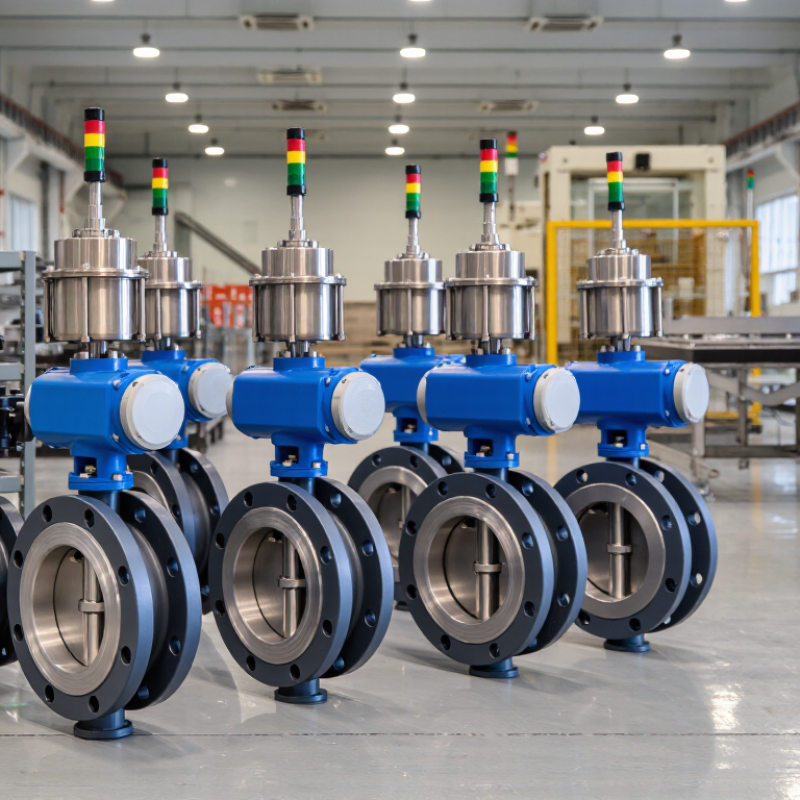
A pneumatic butterfly valve controls flow with a circular disc mounted inside a pipe. A compressed-air actuator turns the disc through roughly 90 degrees. When the disc sits edge-on to the flow, fluid passes with relatively little obstruction. Turned across the bore, it blocks flow. Simple motion. Fast response. This is the basic principle, but actual performance depends on valve design and operating conditions.
The actuator may be double-acting, using air for both opening and closing, or spring-return, which moves the valve to a set position if air is lost. A solenoid valve directs air to the actuator, while a positioner can adjust the disc angle from a control signal. This supports on/off service or flow regulation. Still, not every butterfly valve is suitable for precise throttling. Disc design, pressure drop, and turbulence matter. The quarter-turn description is simplified; torque and shutoff performance can vary under pressure.
Tips: Confirm whether the line needs shutoff or modulation, then match seal and disc materials to the fluid. Check the required fail position and test actuator travel during commissioning; a small mismatch can cause slow or incomplete movement.
Assessing a pneumatic butterfly valve manufacturer in China starts with matching its technical capability to your operating conditions. Share the medium, pressure, temperature, pipe size, and required operating cycle. Ask for a valve-and-actuator datasheet, dimensional drawing, and clear material specifications. Details matter.
Check how the manufacturer verifies sealing, shell strength, and actuator performance. Request sample inspection records and ask whether serial numbers connect finished valves to material and test records. For a representative order, inspect a sample or arrange a live video review of machining, assembly, and testing. A video helps, but it cannot replace independent inspection when the application is critical.
Look closely at the actuator’s torque margin, air-supply requirements, and fail position. Confirm the stated cycle life and test conditions rather than accepting a figure without context. Ask how the team handles drawing revisions, lead-time changes, spare parts, and warranty claims. A low quotation can hide differences in trim, coating, or testing scope. Do not assume every supplier has equal process control; compare evidence, not polished catalogs. Communication quality is useful, though it is not proof of production quality.
China’s notable pneumatic butterfly valve manufacturers are best compared by engineering evidence, not catalog claims. Look for documented valve-body materials, actuator sizing calculations, and traceable pressure-test records. In water-treatment plants, a DN150 valve may cycle frequently; seat wear and fail-safe action can matter more than quoted torque. Ask whether the supplier tests the assembled valve-and-actuator unit under the intended duty cycle.
Grand View Research valued the global butterfly valve market at about US$11.6 billion in 2023. It forecast 8.1% annual growth through 2030. That estimate covers butterfly valves broadly, not pneumatic models alone. Ask suppliers for references involving similar media and operating temperatures; a clean-water test may not represent abrasive slurry service. Confirm test pressure and acceptance criteria in writing.
Tips: Request a sample inspection report. Check actuator response during air loss, enclosure rating, and spare-part lead time. Catalogs help, but evidence matters more. Still, this check can be missed.
| Manufacturer Capability Area | Common Product Options | Relevant Standards or References | What Buyers Should Verify |
|---|---|---|---|
| General industrial butterfly valves | Wafer, lug, and flanged bodies; commonly specified for water, HVAC, and general process services. | GB/T 12238; EN 593; API 609, depending on valve design and project requirements. | Confirm the exact design standard, face-to-face dimensions, pressure class, and connection type for the quoted model. |
| Pneumatic actuator assemblies | Double-acting or spring-return actuators; on/off or modulating control configurations. | ISO 5211 provides interface dimensions for actuator attachment; it does not certify the complete valve assembly. | Check actuator torque against the valve’s required torque throughout the operating range, as well as air supply, fail position, and accessories. |
| Typical size and pressure selection | Industrial offerings commonly include nominal sizes such as DN50–DN1200 and pressure ratings such as PN10 or PN16; availability varies by design. | Applicable dimensional and pressure requirements depend on the selected product standard and project specification. | Request a model-specific size and pressure chart. Do not assume every size, pressure rating, or body style is available in one product series. |
| Body and disc material options | Common body materials include ductile iron, cast iron, cast steel, and stainless steel. Disc and trim options vary by service. | Material grades should be stated using the relevant material specification and supported by traceable documentation when required. | Confirm fluid compatibility, corrosion conditions, material grades, coating details, and material certificates for wetted parts. |
| Seat and service compatibility | Elastomer or polymer seats may be offered, with selection dependent on temperature, pressure, and the conveyed medium. | Seat material limits are product- and compound-specific; a generic material name alone does not establish suitability. | Obtain the manufacturer’s temperature and pressure limits for the exact seat compound and check chemical compatibility with the process fluid. |
| Inspection and pressure testing | Inspection plans may include shell and seat leakage tests, dimensional checks, and functional checks of the actuator assembly. | Common references include API 598, ISO 5208, and GB/T 13927; the applicable test standard should be specified in the order. | Request the test procedure, acceptance criteria, and model-specific test records. Confirm whether testing covers the valve, actuator, or complete assembly. |
| Quality documentation and traceability | Project documentation may include drawings, bills of materials, inspection records, and material or test certificates. | Documentation requirements are normally defined by the purchase specification and applicable project codes. | Agree on required documents, inspection hold points, serial or batch traceability, and approval of drawings before production. |
| Note: This table summarizes common product options, standards, and purchasing checks for pneumatic butterfly valves. It does not rank or identify individual manufacturers. Actual specifications and availability vary by supplier and model; verify all details against the current technical data sheet and purchase documents. | |||
Choosing among pneumatic butterfly valve manufacturers in China means looking beyond polished catalogs. Product quality shows in details: an evenly machined disc, smooth stem movement, consistent seat contact, and clean welds on the body. Ask for pressure-test records and material traceability for the exact valve configuration you plan to buy. A sample that cycles smoothly is useful, but it cannot prove every production batch will match. That needs checking.
Certifications can help, but their scope matters. Confirm that the certificate is current and covers the product, factory, or management system relevant to your order. Do not treat a logo on a brochure as proof of valve performance. Request test methods, inspection criteria, and clear answers about operating pressure and temperature. Small details count.
Service often becomes visible after the order is placed. A capable supplier should clarify actuator sizing, air-supply requirements, connection dimensions, and spare-part availability before production. Ask how quickly technical questions are answered and what happens if an incoming inspection finds a mismatch. Response time is not the whole story; useful, specific answers matter more. A factory visit or video audit can reveal processes, though neither guarantees flawless delivery. I would still check the first shipment carefully. Even a good supplier can miss a detail.
How product quality, certifications, and service differ: a standardized valve-testing benchmark
API 598 specifies minimum shell-test durations by valve size. These durations are a testing benchmark, not a manufacturer score or certification; compare test reports, applicable standards, and after-sales support when evaluating suppliers. Confirm the applicable API 598 edition and requirements in the purchase specification.
Source: API Standard 598, Valve Inspection and Testing — shell-test duration requirements.
Start with the actual service conditions, not a catalog photograph. Tell the manufacturer the fluid, operating temperature, pressure range, pipe size, and how often the valve will cycle. A valve handling clean water may need different seat materials from one exposed to abrasive slurry. Small details matter. Ask whether the body, disc, stem, and seat materials suit your process, and request written confirmation rather than a casual assurance.
The pneumatic actuator should match the valve’s required torque under your worst operating conditions. Ask how the supplier calculated that margin, especially if pressure may fluctuate or the valve could sit unused for long periods. Specify the preferred action on air failure, such as fail-open or fail-closed, and describe any control signals or position feedback you need. A clear datasheet helps prevent mismatched components. It is easy to overlook this.
Check how the manufacturer verifies quality. Request material records, dimensional inspection results, pressure-test procedures, and traceability for the supplied unit. If possible, review a sample test report and ask how production changes are communicated. A factory visit or live inspection can reveal practical details, such as assembly cleanliness and document control.
References from similar applications are useful, though they cannot guarantee your result. I would also ask who handles technical questions after delivery; a quick quotation is not the same as dependable support. No checklist catches everything.