10 Best Large Freeze Dryer Manufacturers Worldwide?
Selecting a reliable Large Freeze Dryer manufacturer requires more than comparing chamber size or advertised capacity. Industrial buyers must examine engineering depth, process consistency, documentation, and long-term service support. A freeze dryer may look impressive in a showroom, yet perform poorly under heavy production schedules. That difference matters.
This guide reviews ten leading Large Freeze Dryer manufacturers worldwide through practical evaluation criteria. These include shelf area, condenser temperature, vacuum stability, loading systems, cleanability, automation, and energy performance. It also considers installation support, operator training, spare-part availability, and validation documentation. Experienced buyers often inspect weld quality, door sealing, refrigeration response, and control-system usability before signing a contract. Small details reveal a great deal.
No single supplier fits every facility. Pharmaceutical production may prioritize aseptic design and strict data integrity. Food manufacturers may focus on throughput, product texture, and operating costs. Research institutions usually need flexible batch control and compact integration. Regional service networks can be just as important as machine specifications. A technically excellent system becomes less valuable when qualified support is difficult to reach.
The manufacturers discussed here represent different strengths, technologies, and market approaches. However, rankings should not replace site-specific testing or professional due diligence. Performance claims deserve verification through factory acceptance tests, reference visits, and documented sample trials. Even this comparison has limits. Product ranges change, and published specifications may omit practical constraints. Readers should use the information as a structured starting point, not a final purchasing decision.
Large Freeze Dryers: Industrial Capacity, −50°C Condensers, and Vacuum Control
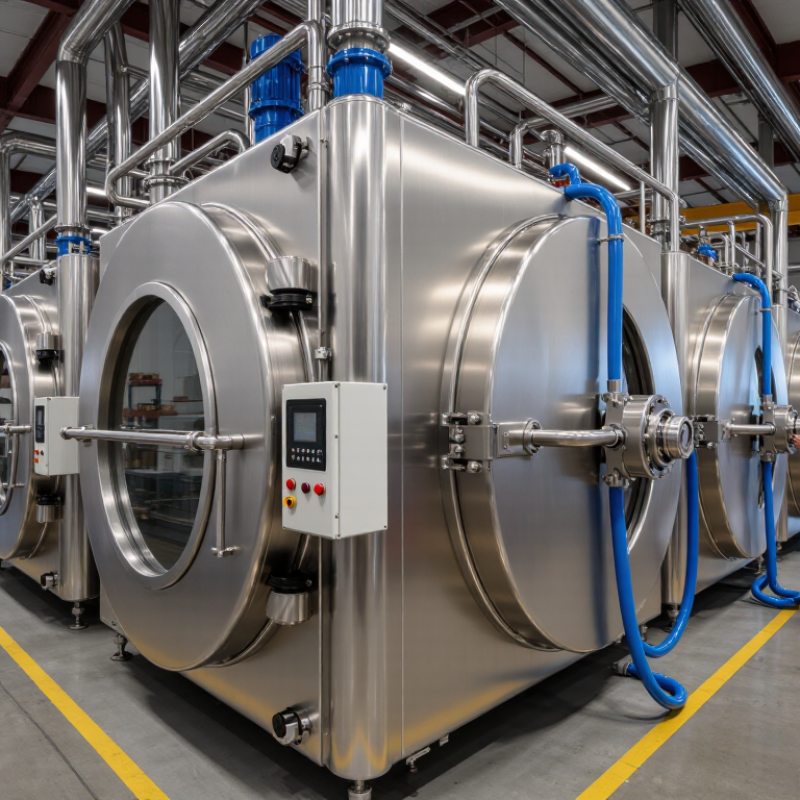
Choosing among the 10 best large freeze dryer manufacturers worldwide requires more than chamber volume. Industrial capacity depends on shelf area, batch thickness, loading method, and product heat sensitivity. A unit rated for 1,000 liters may perform differently with vials, trays, or bulk material. Ask for tested cycle data. Real data matters. Operators should inspect condenser placement, drain design, insulation, and cleaning access. These details affect downtime as much as headline capacity.
A condenser reaching −50°C is useful, but temperature alone does not prove performance. Ice capture rate, vapor flow, and defrost recovery must be evaluated together. During a demanding cycle, the condenser should hold temperature without excessive compressor cycling. Vacuum control also deserves close attention. Reliable systems combine calibrated pressure sensors, automatic isolation valves, and responsive control software. I prefer seeing pressure trends, leak-test results, and shelf-temperature records before approving equipment. Small fluctuations can change drying time and product structure.
Experienced suppliers should provide factory acceptance testing, installation guidance, operator training, and accessible spare parts. Their documentation should explain alarm limits, sensor calibration, and preventive maintenance. Ask how the system behaves during a power interruption. Recovery plans are often overlooked. No design is perfect. A large dryer may save labor yet consume significant utilities if the cycle is poorly tuned. Trial batches, realistic loading patterns, and independent quality reviews reveal weaknesses early. That evidence is more valuable than polished sales language.
How the Top 10 Manufacturers Compare by Shelf Area, Batch Size, and Throughput
10 Best Large Freeze Dryer Manufacturers Worldwide?
Comparing the top ten large freeze dryer manufacturers requires more than checking chamber dimensions. Shelf area shows loading capacity, while batch size indicates usable product volume. Throughput reveals how quickly the system supports repeated production cycles. These figures are related, but they are not interchangeable. A machine with 100 square meters of shelves may still deliver modest output with slow freezing or lengthy drying.
In practical equipment evaluations, leading manufacturers commonly offer shelf areas from 20 to over 200 square meters. Batch capacity may range from several hundred kilograms to several tonnes, depending on formulation and loading density. Throughput varies widely because ice content, vial spacing, condenser performance, and cycle settings affect results. That distinction matters. Published values often describe ideal test conditions, not ordinary factory operation.
A reliable comparison should examine validated cycle data, temperature uniformity, vacuum stability, and cleaning access. Ask for records from products similar to yours. Figures can mislead. I have seen impressive shelf-area claims produce disappointing output when unloading was slow or heat transfer was uneven. Smaller systems may also outperform larger units when changeovers, maintenance, and operator skill are considered. The best choice depends on measured kilograms per cycle, annual demand, available utilities, and the acceptable risk of extending production time. Independent testing remains valuable, especially when specifications appear unusually optimistic.
Leading Global Manufacturers of Pharmaceutical and Food Freeze-Drying Systems
Choosing among the 10 best large freeze dryer manufacturers worldwide requires more than comparing chamber volume. For pharmaceutical systems, proven control over shelf temperature, vacuum stability, condenser capacity, and sterile operation matters. Food producers need similar control, but they also prioritize throughput, product texture, energy use, and cleaning access. Look for documented factory testing, validated software, traceable sensors, and responsive commissioning support. Paper claims are not enough.
Leading global manufacturers usually provide systems built around different batch sizes and product loads. A useful evaluation includes freeze profiles, drying endpoints, leak rates, defrost time, and data integrity. For regulated pharmaceutical production, ask about installation, operational, and performance qualification support. Audit trails and electronic records should match the site’s quality procedures. Food facilities may need automatic loading, robust shelves, and fast changeovers between recipes. Small details become expensive later.
From practical equipment reviews, the strongest supplier is rarely the one with the largest brochure capacity. Engineering fit matters more than a dramatic specification. Request product trials using the real formulation, tray depth, and target residual moisture. Check service coverage, spare-part availability, operator training, and remote diagnostics across your region. I would also question optimistic cycle times. Actual performance can shift with solids content, loading patterns, and ambient conditions. That uncertainty deserves measured testing, not a rushed purchase.
Evaluating GMP Compliance, CIP/SIP Design, and 21 CFR Part 11 Integration
For a global top-ten evaluation, freeze-dryer size is only the starting point. Grand View Research’s 2024 market report forecasts high-single-digit growth for pharmaceutical lyophilization equipment through 2030. That growth raises validation pressure. Buyers should examine GMP evidence, not polished brochures. Factory acceptance testing, change-control records, and service response data reveal more.
CIP and SIP design require physical proof. Inspectors should review spray coverage studies, drainability tests, dead-leg controls, and sterilization temperature maps. EU GMP Annex 1 emphasizes contamination-control strategies for sterile manufacturing. A well-designed chamber should leave no visible pooling after cleaning. SIP cycles also need validated exposure time, temperature, and pressure. Small weaknesses become expensive deviations.
21 CFR Part 11 integration should include secure user roles, time-stamped audit trails, electronic signatures, and controlled record retention. FDA’s Data Integrity guidance links reliable records with complete, consistent, and accurate data. In practice, I would test failed logins, recipe changes, and power recovery during qualification. A modern interface is not enough. It can still hide weak controls. The ISPE Pharma 4.0 framework supports a risk-based approach, but maturity scores are not proof of compliance. No scorecard is perfect. My main concern is often overlooked: data must remain readable and retrievable years later, including calibration history and batch records.
10 Best Large Freeze Dryer Manufacturers Worldwide? — Evaluating GMP Compliance, CIP/SIP Design, and 21 CFR Part 11 Integration
Comparative screening matrix for large-scale pharmaceutical and biopharmaceutical freeze-dryer suppliers. The assessment focuses on commonly documented engineering and compliance capabilities; project-specific confirmation, URS review, and qualification evidence should be requested before procurement.
Evaluation criteria: GMP-oriented mechanical design, cleanability, CIP/SIP integration, electronic records and signatures, audit-trail functionality, recipe control, data integrity, and qualification support. “Configurable” and “Project option” indicate that the capability must be confirmed in the approved URS, functional design specification, and validation protocol.
Selecting a Large Freeze Dryer by Energy Use, Automation, Service, and Cost
Choosing a large freeze dryer starts with the production schedule, not the catalog size. A 100-square-foot shelf area can demand far more power during pull-down than during steady operation. Ask suppliers for measured energy data under a comparable ice load. Test conditions matter. A quoted figure without batch details is weak evidence. Review condenser temperature, vacuum-pump type, defrost method, and heat-recovery options. These details influence utility bills and cycle stability.
Automation should reduce repetitive decisions without hiding important process information. Look for recipe control, calibrated sensors, alarm history, and secure data export. Operators should see shelf temperature, product temperature, pressure, and condenser status on one screen. Remote access can help, but it should not replace local safety checks. Run a sample batch with your own material, if possible. Watch how quickly the system responds when pressure changes. Small delays may become costly across hundreds of cycles. Over-automation is also a risk; unclear prompts can slow an experienced operator.
Service quality often determines the real cost of ownership. Request maintenance intervals, spare-part lead times, training coverage, and response targets in writing. Compare installation, validation support, utilities, consumables, and downtime, not only purchase prices. A cheaper chamber may require more manual cleaning or frequent pump work. That calculation is easy to miss. Ask for references from facilities with similar batch sizes and working hours. Inspect the documentation before signing. Some manuals look complete but leave commissioning responsibilities vague. Build a cost model using conservative assumptions, then challenge every estimate with operating data.
Large Freeze Dryer Selection Benchmark
Non-brand industry reference comparing energy use, automation, service readiness, and cost efficiency.
Scores are normalized on a 0–100 scale for planning purposes. Energy efficiency is based on typical industrial consumption of approximately 1.2–2.0 kWh per kg of water removed; automation reflects recipe-controlled process steps; service readiness considers remote monitoring, spare-parts availability, and response time; cost efficiency considers purchase price, installation, maintenance, and operating cost. Higher scores indicate a more favorable overall position.