What Is the Best Commercial Freeze Dryer from China?
Choosing the best Commercial Freeze Dryer from China starts with the product, not the brochure. A machine for berries may not suit coffee, herbs, or prepared meals. Batch size, tray area, condenser capacity, and final moisture targets all matter. So does the daily rhythm of your plant. Can operators load the shelves safely? Can they clean the chamber without awkward workarounds? These details are easy to overlook.
Lyophilization researcher Dr. Anthony I. Liapis has emphasized the close relationship between heat transfer and water-vapor removal in freeze-drying. That principle offers a useful way to judge equipment: ask how the system controls shelf temperature, vacuum, and product behavior during each stage. Look for test data, clear cycle controls, service access, and references from comparable production settings. A polished screen is not proof. Neither is a low quote.
This guide compares Chinese commercial models by capacity, process control, build quality, support, and total operating demands. It also considers what a supplier can document, rather than what a sales page simply promises. Small differences count. A poorly placed drain, a slow service response, or inconsistent batch results can cost more than the initial discount. There is no universal winner, and the comparison may still leave questions. That is worth admitting. The best choice is the machine that fits your product and team reliably, not the one with the loudest claim.
Freeze-Drying Fundamentals: Sublimation Below Water’s 611 Pa Triple Point
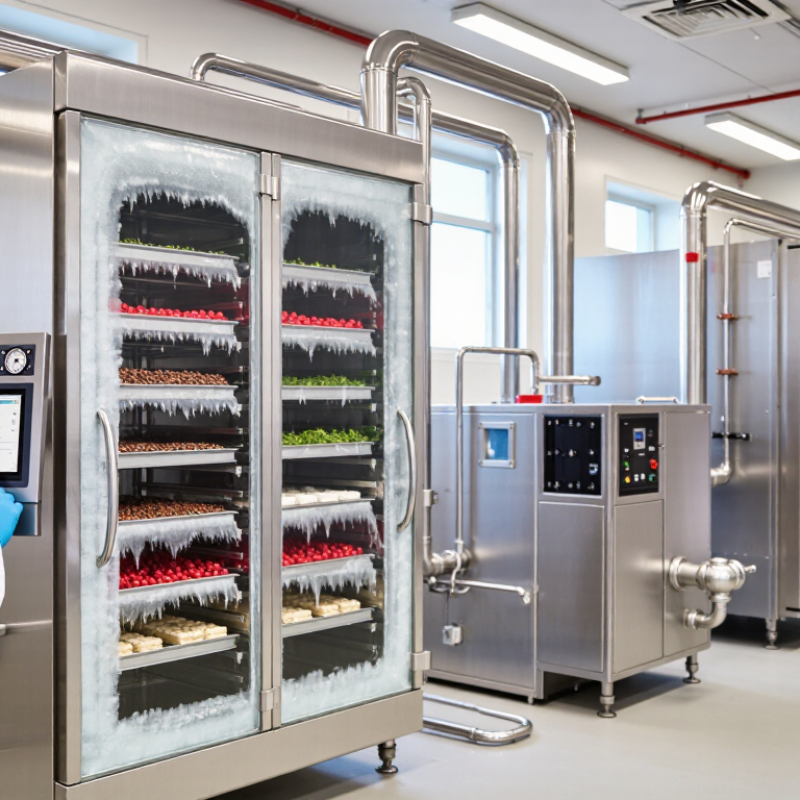
In freeze-drying, the key idea is keeping water below its triple-point pressure of about 611 Pa absolute. Near the triple point, water can exist as ice, liquid, and vapor. Below it, ice can turn directly into vapor without passing through a liquid phase. That change is sublimation. The frozen product sits on a chilled shelf while carefully controlled heat supplies energy for vapor removal. Too little heat can slow drying; too much may soften or damage the product. The balance is delicate. A cold condenser captures water vapor before it reaches the vacuum pump. Pressure alone does not tell the whole story. Product temperature matters, too.
When assessing a commercial freeze dryer, look for stable vacuum control, uniform shelf temperatures, and enough condenser capacity for the batch size. Ask how the system measures pressure and product temperature, and whether its readings are checked during operation. A sensor reading is only useful when its location and calibration are understood. Real batches are less tidy than diagrams. Tray loading, product thickness, and moisture content can change drying time. I would not treat one successful cycle as proof of consistent performance. Request operating records or a controlled trial using a representative load. Watch for unevenly dried areas, ice buildup, and changes in product texture. The basic physics is clear; applying it evenly across a full chamber takes careful process control.
| Evaluation Dimension | Technical Fact or Typical Practice | What to Check When Selecting a Commercial Unit |
|---|---|---|
| Water’s triple point | Pure water’s triple point is approximately 611.657 Pa absolute pressure and 0.01°C. Below this pressure, liquid water is not stable at equilibrium. | Confirm that pressure readings are absolute pressure, not gauge pressure, and that the control system can maintain the required vacuum. |
| Primary-drying principle | In primary drying, ice is removed mainly by sublimation: frozen water changes directly into water vapor under vacuum. The product must remain frozen and below its product-specific critical temperature. | Ask how shelf temperature and chamber pressure are controlled, and how the cycle is developed for the actual formulation and container. |
| Typical primary-drying pressure | Commercial processes often operate at chamber pressures in the approximate range of 10–100 Pa during primary drying. The appropriate setpoint depends on the product, equipment, and process design. | Request pressure-control and measurement specifications across the intended operating range; do not select equipment from a maximum-vacuum figure alone. |
| Product temperature limits | The allowable product temperature is formulation-dependent. Exceeding the collapse temperature of an amorphous product, or the relevant eutectic limit of a crystalline product, can damage structure and quality. | Check whether the dryer supports product-temperature monitoring and controlled shelf ramps, and validate limits using product-specific development work. |
| Ice condenser | The condenser captures water vapor during drying. Commercial systems commonly use cold condensers, often designed for temperatures of −50°C or lower; the required capacity and temperature depend on the process. | Compare ice-capture capacity per batch, condenser temperature under load, defrost method, and how condenser performance is documented. |
| Shelf area and batch capacity | Batch capacity depends on usable shelf area, vial or tray geometry, fill depth, loading pattern, and the product’s drying behavior. Nominal capacity alone does not determine achievable throughput. | Request a capacity estimate for the specific container, fill volume, and batch layout—not just a quoted maximum number of vials or kilograms. |
| Secondary drying | After most ice has been removed, secondary drying reduces residual moisture by desorption, typically using controlled heating under vacuum. | Check the available shelf-temperature range, recipe controls, and whether the proposed cycle can meet the product’s residual-moisture target. |
| Controls and records | Repeatable freeze-drying depends on coordinated control of shelf temperature, chamber pressure, condenser conditions, and cycle steps. | Assess recipe management, alarms, data export, batch records, sensor calibration, and access controls against your quality and regulatory requirements. |
| Materials and cleanability | Product-contact surfaces and chamber design should suit the product, cleaning method, and intended operating environment. | Review material certificates, surface finish, drainability, cleaning procedures, and any required validation documentation. |
| Installation and service | Performance depends on utilities, installation conditions, operator training, maintenance, and access to qualified service. | Confirm power and cooling requirements, commissioning support, spare-parts availability, warranty terms, and service response arrangements in your region. |
| Choosing the “best” unit | There is no universally best commercial freeze dryer: the right configuration depends on product sensitivity, batch size, cycle time, quality targets, and facility requirements. | Compare documented performance using your intended product and load, and verify quoted specifications through acceptance testing and process validation. |
Note: Operating ranges are general reference points, not guaranteed specifications. Actual cycle conditions and equipment capabilities vary by product, process, and system design.